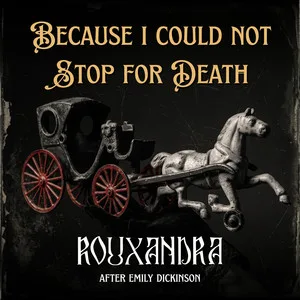
Because I could not stop for Death
- Author
- Emily Dickinson
- Date
- c. 1862
- Language
- English
- Country

- Form
- Lyric poem in common meter, with alternating tetrameter and trimeter lines, slant rhyme, repetition and Dickinson’s characteristic dashes
- First published
- Poems, First Series, 1890 (posthumous, edited)
- Themes
- death, time, immortality
The source
Because I could not stop for Death –
He kindly stopped for me –
The Carriage held but just Ourselves –
And Immortality.
We slowly drove – He knew no haste
And I had put away
My labor and my leisure too,
For His Civility –
We passed the School, where Children strove
At Recess – in the Ring –
We passed the Fields of Gazing Grain –
We passed the Setting Sun –
Or rather – He passed Us –
The Dews drew quivering and Chill –
For only Gossamer, my Gown –
My Tippet – only Tulle –
We paused before a House that seemed
A Swelling of the Ground –
The Roof was scarcely visible –
The Cornice – in the Ground –
Since then – 'tis Centuries – and yet
Feels shorter than the Day
I first surmised the Horses' Heads
Were toward Eternity –
Commentary
 Dr. Ruxandra RouxHead of Literary Research & Development
Emily Dickinson, around 1862, in her most productive stretch. No particular death is known to have prompted it. Death shows up as a polite gentleman with a carriage and takes her for a drive.
What makes it chilling is how calm it is. Death is never violent. He is courteous, patient, almost good company. They pass children at play, fields of grain and the setting sun, a whole life in a few stanzas, and only then does she notice where they are going: a “House” that seems built into the ground. The poem never says what comes after. It only says that she has handed over the reins. Notice who is driving. It was first published in 1890, in an edited version that changed her punctuation and wording. Modern editions go back to the manuscript.
Songs
The song made from Because I could not stop for Death.