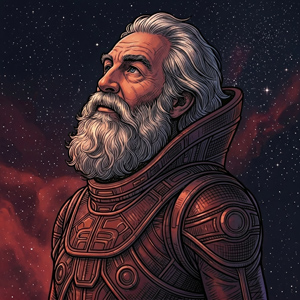
Field Report
Filed under Whitman, first printed in Drum-Taps, later folded into Leaves of Grass, where it eventually settled in the “By the Roadside” cluster. Cross-referenced: Proof, Silence, Stars. Eight lines, one sentence, a lecture hall walked out of.
Below: the source text as Whitman left it, the lyric as it now exists on tape, and our notes on a song that, like several other files in this collection, ends up quoting its source's last line for a title.
The Source
When I heard the learn’d astronomer,
When the proofs, the figures, were ranged in columns before me,
When I was shown the charts and diagrams, to add, divide, and measure them,
When I sitting heard the astronomer where he lectured with much applause in the lecture-room,
How soon unaccountable I became tired and sick,
Till rising and gliding out I wander’d off by myself,
In the mystical moist night-air, and from time to time,
Look’d up in perfect silence at the stars.
The Resurrection
Verse 1
When I heard the learn’d astronomer,
When the proofs, the figures, were ranged in columns before me,
When I was shown the charts and diagrams, to add, divide, and measure them, (to measure them)
Chorus
When I, wandering by myself,
In the mystical moist night-air, and from time to time,
Look’d up in perfect silence at the stars.
Verse 2
When I sitting heard the astronomer where he lectured with much applause in the lecture-room,
How soon unaccountable I became tired and sick,
Till rising and gliding out I wander’d off by myself, (gliding out)
Chorus
When I, wandering by myself,
In the mystical moist night-air, and from time to time,
Look’d up in perfect silence at the stars. (at the stars)
Outro Look’d up in perfect silence…
Notes from the Archivists
Whitman's poem is one sentence, eight lines, and it splits cleanly down the middle: four lines of the astronomer's proofs, columns, charts, and applause, then four lines of a man leaving the room. The whole poem is a demonstration by contrast — measurement on one side, direct unmeasured looking on the other — and the two halves don't argue with each other so much as one simply gets up and walks out on the other.
The song makes that split literal by turning the second half into the chorus. Everything about counting, dividing, and lecturing stays in the verses; everything about wandering off and looking up stays in the chorus, repeated, returned to, the thing the song keeps coming back around to the way the poem's speaker keeps looking up “from time to time.” The astronomer's material never earns a repeat. The night sky does.
It's also, structurally, the same move this archive keeps finding across very different sources: whatever a poem ends on has a way of becoming what the song opens and closes on too. Here that's literal down to the title — “Perfect Silence at the Stars” isn't Whitman's title at all (he left the poem untitled, folded into a numbered cluster); it's his last eight words, compressed. The song reaches past however the poem is usually filed and pulls out the moment it stops arguing and just looks.
The outro trims even that down further, cutting the sentence off before its object: “Look'd up in perfect silence…” with the stars themselves left unsaid, the ellipsis doing what the poem's line break already does — holding the silence a beat longer than grammar strictly requires.
 Play on Spotify
 Play on Apple Music