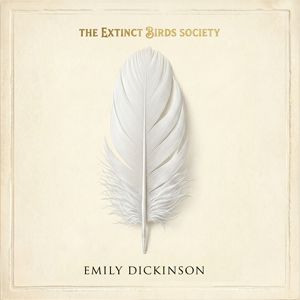
Field Report
Filed under Fascicle 13, specimen 254 in Johnson's numbering, 314 in Franklin's. Cross-referenced: Hope, Bird, Extremity. The Society does not write songs. We restore them — and this is the restoration log for the one Dickinson manuscript that happened to already be about a bird that never stops singing.
Below: the source text exactly as it survives in the fascicle, the lyric as it now exists on tape, a map of what moved where, and our notes on why.
The Source
“Hope” is the thing with feathers —
That perches in the soul —
And sings the tune without the words —
And never stops — at all —
And sweetest — in the Gale — is heard —
And sore must be the storm —
That could abash the little Bird
That kept so many warm —
I’ve heard it in the chillest land —
And on the strangest Sea —
Yet — never — in Extremity,
It asked a crumb — of me.
The Resurrection
Verse 1
And sweetest — in the Gale — is heard — (is heard)
And sore must be the storm —
That could abash the little Bird
That kept so many warm —
Chorus
“Hope” is the thing with feathers —
That perches in the soul —
And sings the tune without the words — (no words)
And never stops — at all —
Verse 2
I’ve heard it in the chillest land —
And on the strangest Sea —
Yet — never — in Extremity,
It asked a crumb — of me. (not a crumb)
Chorus
“Hope” is the thing with feathers —
That perches in the soul —
And sings the tune without the words —
And never stops — at all —
Chorus
“Hope” is the thing with feathers —
That perches in the soul —
And sings the tune without the words —
And never stops — at all —
Outro
(It never stops)
In the soul.
Notes from the Archivists
Dickinson's poem is built on one extended metaphor and refuses to let go of it: hope is not a feeling you generate, it's a small bird that has already taken up residence in you, uninvited and unbothered by weather. The famous line is the third one — “sings the tune without the words” — because it names the poem's own method. Dickinson writes about a song with no lyrics inside a poem that is, itself, mostly punctuation: nine of twelve lines end in a dash, a stammering, unresolved breath that the words keep almost-arriving at and never quite landing on.
The lyric doesn't sing the poem in the order Dickinson left it. Stanza one — the definition of hope — is lifted out of its position as the poem's opening and installed instead as the refrain, returning three times over the course of the song. That's a faithful move as much as a practical one: a refrain is, by definition, the part of a song that comes back no matter what the verses just said — which is exactly what stanza one claims hope does. The words don't just describe the mechanism. Rearranged like this, they perform it.
What's left after the refrain is pulled forward reads almost like an argument settling itself: the storm stanza first, then the definition, then the hardest and quietest of Dickinson's lines closing verse two — “it asked a crumb of me” — hope as something that costs the one holding it nothing, which is either the most comforting or the most damning reading in the whole poem, depending on the day you're having. The outro trims that ending further still, down to two isolated fragments — “never stops,” “in the soul” — the two phrases the poem was arguably circling all along.
The lyric sheet also marks a handful of echoed asides under the main lines — (is heard), (no words), (not a crumb) — each repeating the word Dickinson had just placed at the end of its own line. Read as text, they work like a second voice glossing the first in real time: an echo answering an echo, which is a fairly literal way to set a poem about something that sings without the words — even the gloss adds nothing new, it just repeats what was already there.
And there's the matter of who's credited on the file. A Dickinson poem about a bird that supposedly never stops, revived by an act calling itself the Extinct Birds Society, sung with Fay Dodo — herself named for a bird whose entire reputation rests on having stopped, permanently, several centuries ago. We didn't invent that irony. We just noticed it was already sitting in the record.
 Play on Spotify
 Play on Apple Music