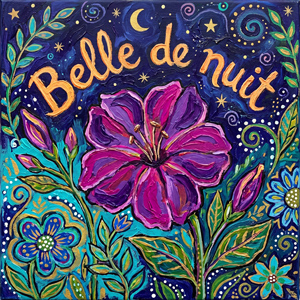
Field Report
Filed under Nau, part of Haiti's first generation of Romantic poets writing after independence, active in the 1830s and ’40s, dead by thirty-three. Cross-referenced: Flower, Dusk, Desire. A sonnet about a flower that only opens after the sun goes down, set to music by an artist who calls the space between the altar and the dance floor home.
Below: the source text as Nau left it, the lyric as it now exists on tape, and our notes on a song that ends by going back to where it started.
The Source
Ô ma belle-de-nuit, ferme, ferme ta robe,
Car la lune est bien pâle à l’horizon du soir ;
Retiens les doux parfums de ton pur encensoir ;
Le matin est éclos sous les regards de l’aube.
Le rayon du soleil est pour toi trop brûlant ;
Humble fleur, cache-toi sous l’épaisse ramée,
Jusqu’à ce que la nuit et sa brise embaumée
Ramènent dans le ciel le timide croissant.
Alors tu reprendras ta pourpre nuancée ;
Tu verras briller entre tous tes amants
La mouche voyageuse aux yeux de diamants.
Quels baisers, quels soupirs, heureuse fiancée !
Lorsqu’en ton lit d’amour, tes charmes disputés
Rassembleront, ce soir, l’essaim des voluptés.
“Oh my flower of the night, close your petals — the moon is pale on the evening horizon. Hold your sweet perfume; morning is opening under the gaze of dawn. The sun's ray is too bright for you; humble flower, hide beneath the thick branches, until night and its scented breeze bring the timid crescent moon back to the sky. Then you'll take back your tinted purple; you'll see the diamond-eyed traveling fly shine among all your suitors. What kisses, what sighs, happy bride — when tonight, in your bed of love, your contested charms gather the swarm of pleasures.”
The Resurrection
Chorus
Ô ma belle-de-nuit, ferme, ferme ta robe,
Car la lune est bien pâle à l’horizon du soir ;
Retiens les doux parfums de ton pur encensoir ;
Le matin est éclos sous les regards de l’aube. (Ferme ta robe)
Verse 1
Le rayon du soleil est pour toi trop brûlant ;
Humble fleur, cache-toi sous l’épaisse ramée,
Jusqu’à ce que la nuit et sa brise embaumée
Ramènent dans le ciel le timide croissant. (Le timide croissant)
Chorus
Ô ma belle-de-nuit, ferme, ferme ta robe,
Car la lune est bien pâle à l’horizon du soir ;
Retiens les doux parfums de ton pur encensoir ;
Le matin est éclos sous les regards de l’aube. (Sous les regards)
Verse 2
Alors tu reprendras ta pourpre nuancée ;
Tu verras briller entre tous tes amants
La mouche voyageuse aux yeux de diamants.
Quels baisers, quels soupirs, heureuse fiancée ! (Heureuse fiancée)
Bridge
Lorsqu’en ton lit d’amour, tes charmes disputés
Rassembleront, ce soir, l’essaim des voluptés. (Des voluptés)
Chorus
Ô ma belle-de-nuit, ferme, ferme ta robe,
Car la lune est bien pâle à l’horizon du soir ;
Retiens les doux parfums de ton pur encensoir ;
Le matin est éclos sous les regards de l’aube.
Outro (Belle-de-nuit…)
Notes from the Archivists
Nau's sonnet is built the way sonnets usually are: two quatrains setting the scene, two tercets turning it. The octave tells the flower to close up against the sun; the sestet promises what happens once night lets it open again, ending on the poem's frankest line — “l'essaim des voluptés,” the swarm of pleasures gathering in “ton lit d'amour,” your bed of love. It's a poem about a plant with an unmistakably human ending.
The song, like several other files in this collection, promotes the opening quatrain to chorus and repeats it well past its original single appearance. What's different here is what happens at the very end. Every other entry in this archive that reorders its source still finds a way to close on the source's own final line or a fragment of it. This one doesn't. The bridge delivers Nau's actual last couplet — the “essaim des voluptés” payoff the whole poem was building toward — and then the song moves past it, back to the chorus, back to “ferme, ferme ta robe,” ending where it began instead of where Nau ended.
That's arguably the more faithful choice for this particular flower. A belle-de-nuit doesn't bloom once and finish; it closes at dawn and opens again at dusk, night after night, on a loop that doesn't know from “ending.” A song that resolved on the poem's climax would be more conventional. A song that circles back to close, close your dress after already showing you what happens when it opens is staying loyal to the plant's actual schedule.
There's also the matter of who wrote it. Ignace Nau was writing in Haiti roughly a decade after Pindemonte finished his Odyssey and a generation before Dickinson's fascicles — part of the first wave of Haitian writers working in French Romantic form to build a literature of their own, right after independence. He died young, largely uncelebrated outside specialist circles since. Filed here next to Baudelaire and Poe, on equal footing, is roughly the point.
 Play on Spotify
 Play on Apple Music