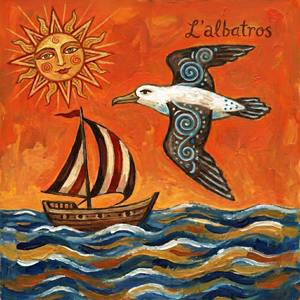
Field Report
Filed under Baudelaire, second poem of Les Fleurs du Mal’s second edition, opening section “Spleen et Idéal.” First printed 1859, in the Revue française, two years before the fuller collection. Cross-referenced: Bird, Exile, Wings.
Below: the source text as Baudelaire left it, the lyric as it now exists on tape, and our notes on how the song handles a poem that spends three full stanzas withholding its own point.
The Source
Souvent, pour s’amuser, les hommes d’équipage
Prennent des albatros, vastes oiseaux des mers,
Qui suivent, indolents compagnons de voyage,
Le navire glissant sur les gouffres amers.
À peine les ont-ils déposés sur les planches,
Que ces rois de l’azur, maladroits et honteux,
Laissent piteusement leurs grandes ailes blanches
Comme des avirons traîner à côté d’eux.
Ce voyageur ailé, comme il est gauche et veule !
Lui, naguère si beau, qu’il est comique et laid !
L’un agace son bec avec un brûle-gueule,
L’autre mime, en boitant, l’infirme qui volait !
Le Poète est semblable au prince des nuées
Qui hante la tempête et se rit de l’archer ;
Exilé sur le sol au milieu des huées,
Ses ailes de géant l’empêchent de marcher.
The Resurrection
Verse 1
Souvent, pour s’amuser, les hommes d’équipage
Prennent des albatros, vastes oiseaux des mers,
Qui suivent, indolents compagnons de voyage,
Le navire glissant sur les gouffres amers.
Verse 2
À peine les ont-ils déposés sur les planches,
Que ces rois de l’azur, maladroits et honteux,
Laissent piteusement leurs grandes ailes blanches
Comme des avirons traîner à côté d’eux.
Pre-Chorus
Ses ailes de géant…
Ses ailes de géant…
L’empêchent de marcher.
L’empêchent de marcher.
Chorus
Le Poète est semblable au prince des nuées
Qui hante la tempête et se rit de l’archer ;
Exilé sur le sol au milieu des huées,
Ses ailes de géant l’empêchent de marcher !
Verse 3
Ce voyageur ailé, comme il est gauche et veule !
Lui, naguère si beau, qu’il est comique et laid !
L’un agace son bec avec un brûle-gueule,
L’autre mime, en boitant, l’infirme qui volait !
Bridge
L’infirme qui volait !
L’infirme qui volait !
Exilé sur le sol !
Au milieu des huées !
Chorus
Le Poète est semblable au prince des nuées
Qui hante la tempête et se rit de l’archer ;
Exilé sur le sol au milieu des huées,
Ses ailes de géant l’empêchent de marcher !
Outro
Ses ailes de géant…
L’empêchent de marcher.
L’empêchent de marcher.
Notes from the Archivists
Baudelaire spends three full stanzas making his reader watch an albatross get mocked before he tells you what it means. Sailors catch the bird for sport; on deck, the same wings that made it a “king of the blue” in flight make it clumsy and ridiculous, dragged like oars at its sides. Only in the fourth and final stanza does the poem name what it's actually been describing: “Le Poète est semblable au prince des nuées” — the Poet, exiled on the ground, jeered at, his giant wings the very thing that keeps him from walking among everyone else. The whole poem is built as a three-stanza wait for one line.
The song doesn't honor that wait. It lifts the poem's last line — “ses ailes de géant l'empêchent de marcher” — and plants it as a pre-chorus immediately after the second verse, well before verse three has even finished describing the bird being mocked. By the time the chorus formally arrives and names the Poet outright, the song has already taught the ear to expect that line as a hook, stripped of the reveal it was built to deliver. Baudelaire makes you sit through the humiliation before he explains it. The song explains it early, then makes you sit through the humiliation anyway — verse three, describing the mockery in full, now arrives after we already know it's a metaphor for the artist, which turns comedy into something closer to a wound reopened on purpose.
The bridge leans into that reversal: fragments of the poem's harshest images — “l'infirme qui volait,” “the cripple who used to fly” — get repeated as chant, stripped of their sentence, closer to taunt than description. It's the sailors' mockery restaged as the song's own rhythm section, which is either a faithful staging of the poem's cruelty or the song briefly becoming one of the sailors itself, depending on how charitably you want to read a breakdown.
And there's a version of this that reads as a mission statement disguised as a bird. A poet whose greatness is inseparable from the thing that makes them unable to walk normally among other people — exiled on the ground, laughed at, still the prince of clouds the second the ground lets go of them. It's not a hard leap from that to an artist persona built around extinction, and it's not a coincidence that this file sits in the same archive as birds that supposedly can't sing anymore.
 Play on Spotify
 Play on Apple Music